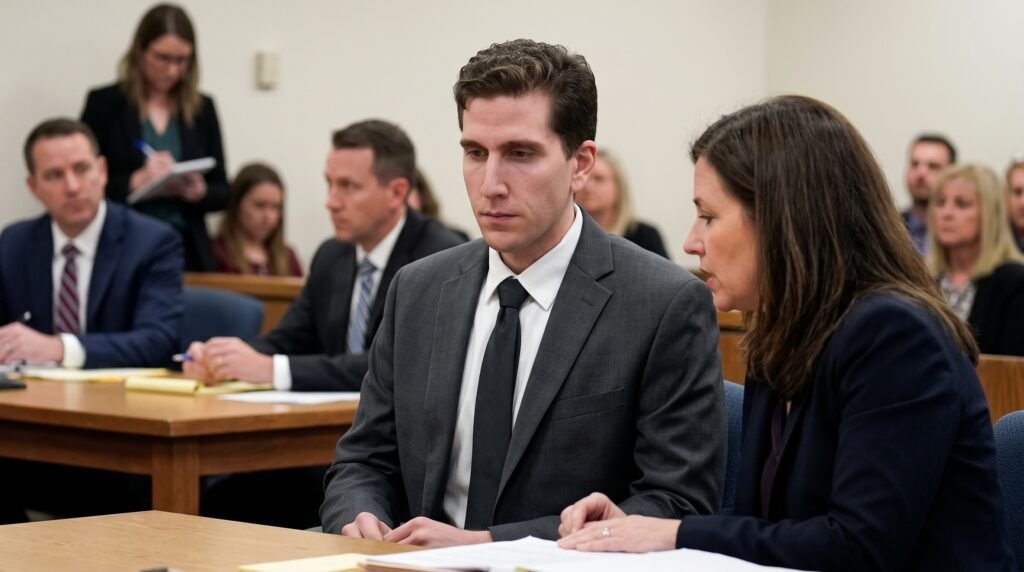

The question of the Bryan Kohberger motive has remained one of the most discussed aspects of the Idaho student murders. Although Bryan Kohberger pleaded guilty in connection with the killings of four University of Idaho students, the exact reason behind the crimes has never been publicly confirmed by him. As a result, investigators, legal experts, journalists, and the public have continued to examine available evidence while distinguishing verified facts from speculation.
Understanding the Bryan Kohberger motive requires separating courtroom evidence from internet rumors. While many theories have circulated online, only information supported by official court records, law enforcement statements, and established reporting should be considered reliable. This article explains what is currently known, the leading theories discussed during the investigation, and why many questions may never receive definitive answers.
Why the Bryan Kohberger Motive Matters
Determining a criminal motive helps investigators reconstruct events, explain a suspect’s behavior, and provide context during legal proceedings. However, motive is not always required to obtain a conviction or guilty plea.
In Kohberger’s case, prosecutors focused primarily on evidence linking him to the crime rather than proving a specific psychological or personal motive. This approach is common in criminal cases where physical evidence, digital records, and admissions establish guilt regardless of why the crime occurred.
For many people following the case, however, understanding the motive remains important because it could help explain how such a tragic event unfolded.
The Idaho Student Murders
In November 2022, four University of Idaho students were found fatally stabbed inside an off-campus residence in Moscow, Idaho. The victims were:
- Kaylee Goncalves
- Madison Mogen
- Xana Kernodle
- Ethan Chapin
The murders shocked communities across the United States and attracted international media attention. The investigation quickly became one of the most closely followed criminal cases in recent years due to its complexity and the absence of an immediate suspect.
Weeks later, investigators arrested Bryan Kohberger, a graduate student studying criminology at a nearby university.
What Evidence Linked Bryan Kohberger to the Crime?
Although public attention often centered on possible motives, investigators relied on multiple forms of evidence during the case.
Key evidence discussed publicly included:
- DNA evidence recovered from a knife sheath.
- Cell phone records showing movements before and after the crimes.
- Vehicle surveillance matching a white Hyundai Elantra.
- Security camera footage from surrounding neighborhoods.
- Digital evidence collected during the investigation.
These forms of evidence played a much larger role in establishing the case than any confirmed explanation for why the murders occurred.
Has Bryan Kohberger Ever Explained His Motive?
The short answer is no.
Despite widespread public interest, Bryan Kohberger has not publicly provided a detailed explanation describing why the murders occurred.
His guilty plea resolved the criminal case without a public trial, meaning many pieces of evidence that might have been presented before a jury were never fully explored in open court.
As a result, no official narrative explaining his personal motivations has been established.
Leading Theories About the Bryan Kohberger Motive
Because no confirmed explanation exists, several theories have been discussed by journalists, legal analysts, and criminal behavior experts. It is important to remember that these theories are interpretations rather than proven facts.
Possible Targeted Attack
Some observers believe the attack may have been directed toward one or more victims rather than being completely random.
This theory emerged because of the nature of the crime and discussions surrounding possible surveillance of the residence before the murders.
However, investigators have not publicly confirmed that any specific victim was intentionally selected for a known reason.
Interest in Criminal Behavior
Bryan Kohberger studied criminology, leading some commentators to question whether his academic interests influenced his actions.
This connection generated enormous media attention because criminology examines criminal behavior, forensic science, and investigations.
Still, there is no verified evidence showing that his academic studies directly motivated the crimes.
Studying criminology does not predict violent behavior, and experts caution against assuming a relationship between education and criminal conduct.
Obsession or Fixation
Another commonly discussed theory suggests the possibility of an unhealthy fixation on one or more victims.
Some reports suggested investigators examined possible social media interactions and digital activity.
However, no official finding has established a confirmed relationship between Kohberger and any victim before the murders.
Without documented evidence demonstrating personal interaction, this theory remains unconfirmed.
Psychological Factors
Many criminal cases involve psychological analysis after an arrest.
Mental health professionals sometimes evaluate personality traits, behavioral patterns, and life history to understand violent crimes.
In this case, no publicly released psychological evaluation has definitively identified the Bryan Kohberger motive.
Experts generally avoid diagnosing individuals without complete clinical evaluations and reliable evidence.
Why Authorities Have Not Confirmed a Motive
People often assume investigators always discover exactly why a crime occurred.
In reality, that is not always possible.
Several factors may prevent authorities from identifying a clear motive:
- The suspect chooses not to explain.
- Evidence does not establish intent.
- Multiple motivations may exist.
- Important evidence remains unavailable.
- A plea agreement ends the case before additional testimony is presented.
The Kohberger case illustrates how a criminal investigation can establish responsibility without fully explaining personal motivation.
The Difference Between Evidence and Speculation
The internet has produced countless discussions about the Bryan Kohberger motive.
Some articles rely heavily on anonymous sources, social media claims, or unsupported theories.
Responsible reporting distinguishes between:
Verified Information
Verified information comes from:
- Court documents
- Official law enforcement statements
- Judicial proceedings
- Public filings
- Confirmed evidence
Speculation
Speculation includes:
- Social media rumors
- Anonymous online posts
- Unsupported psychological diagnoses
- Viral conspiracy theories
- Claims without official confirmation
Understanding this distinction helps readers evaluate information more critically.
Why Criminal Motives Can Be Difficult to Understand
Human behavior is often complex.
Criminal investigations frequently uncover multiple contributing factors rather than one simple explanation.
Potential influences in violent crimes can include:
- Personal grievances
- Psychological conditions
- Opportunity
- Obsession
- Social isolation
- Emotional instability
- Impulsive decision-making
Even when investigators identify contributing circumstances, they may never determine the precise internal reasoning behind a person’s actions.
That is why many criminal cases remain only partially explained despite successful prosecutions.
The Role of Digital Evidence
Modern investigations increasingly rely on technology.
In the Idaho case, digital evidence reportedly helped investigators reconstruct movements before and after the crimes.
Digital evidence may include:
- Cell phone location records
- Security camera footage
- Vehicle tracking
- Electronic purchases
- Internet activity
- Digital communications
These investigative tools often establish timelines more effectively than eyewitness testimony alone.
However, digital evidence can show where someone was without necessarily revealing why they acted.
Public Interest in the Bryan Kohberger Motive
The case generated extraordinary media attention for several reasons.
It involved multiple victims, a college community, forensic investigation, and significant public uncertainty during the early stages of the investigation.
As information emerged gradually, online discussions expanded rapidly.
True crime podcasts, documentaries, television coverage, and social media platforms all contributed to continued public interest.
Many people continue searching for answers because understanding motive can provide a sense of closure, even when definitive answers are unavailable.
Lessons From the Case
Several broader lessons emerge from examining the Bryan Kohberger case.
First, criminal investigations depend on evidence rather than assumptions. Public opinion may shift quickly, but investigators must rely on verifiable facts.
Second, internet speculation often spreads faster than confirmed information. Readers should always compare claims with official records before accepting them as true.
Third, motive and guilt are separate legal concepts. Prosecutors can establish criminal responsibility through evidence even if the exact motive remains uncertain.
Finally, the case highlights the importance of responsible journalism. Accurate reporting avoids exaggeration and clearly distinguishes verified facts from unanswered questions.
What We Still Do Not Know
Although much has become publicly known about the investigation, important questions remain unanswered.
These include:
- Whether one victim was specifically targeted.
- Whether Kohberger had prior contact with any victim.
- Whether additional personal motivations existed.
- Whether he will ever publicly explain his actions.
- Whether all investigative findings will become public in the future.
Without further statements or newly released evidence, these questions may remain unresolved indefinitely.
Conclusion
The search for the Bryan Kohberger motive continues because no definitive explanation has been publicly confirmed. While investigators assembled substantial evidence linking Bryan Kohberger to the Idaho student murders, establishing why the crimes occurred proved far more difficult than proving who committed them. Various theories—including targeted violence, personal fixation, and psychological factors—have been discussed, but none has been officially verified as the sole motive.
For anyone seeking reliable information, the most trustworthy approach is to rely on court records, official investigative findings, and established reporting rather than speculation. Until Bryan Kohberger provides a credible explanation or additional verified evidence emerges, the exact motive behind one of the most closely followed criminal cases in recent history is likely to remain one of its greatest unanswered questions.